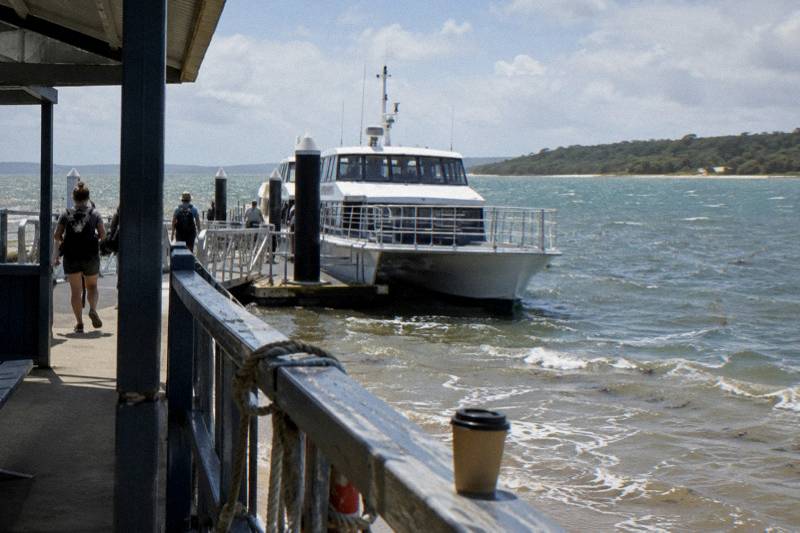
Straddie Wildlife Tours: Kangaroos, Koalas, Turtles And Manta Rays
North Stradbroke Island (Minjerribah) is one of the few places near a capital city where koalas, kangaroos, wallabies, turtles, dolphins, manta rays and migrating humpback whales all sit on the same wildlife list. Here is what Queensland Parks actually says lives there, which trips look for what, and how to read the sightings.
Short answer
Queensland Parks names a genetically distinct koala population, kangaroos, golden wallabies, turtles, dolphins and manta rays on the island, with humpback whales passing close to the coastline from June to November. Three guided day trips from Brisbane look for koalas and kangaroos, from A$149 per person, all with the return ferry and free cancellation up to 24 hours before start.
Wildlife is the reason most people give for taking a guided tour of North Stradbroke Island (Minjerribah) rather than driving it themselves. The island, about 40 km south-east of Brisbane on the eastern side of Moreton Bay, is the second largest sand island in the world, and about 50 per cent of it is Naree Budjong Djara National Park, jointly managed by the Quandamooka people and Queensland Parks and Wildlife Service since 2011. Moreton Bay Marine Park surrounds the whole island. Put those two facts together and you get an unusual concentration of animals within an easy day trip of a state capital: a koala population Queensland Parks describes as genetically distinct, eastern grey kangaroos, golden wallabies found only on the North and South Stradbroke islands, turtles, dolphins and manta rays in the bay, and humpback whales passing close to the coastline from June to November.
No guide can promise you any of them. Sightings are possible, never certain, and any tour that guarantees a koala or a whale is selling something the park service does not. This article, published by North Stradbroke Island Tours, sets out what Queensland Parks actually says lives on the island, where the animals are placed, which guided day trips look for which species, and how to plan a day that gives you the best odds without pretending the odds are a certainty.
What Wildlife Actually Lives On North Stradbroke Island?
North Stradbroke Island's official wildlife list, per Queensland Parks, includes a genetically distinct koala population, kangaroos, golden wallabies (a swamp wallaby form found only on North and South Stradbroke), turtles, dolphins, manta rays and humpback whales, while the surrounding waters of Moreton Bay Marine Park add dugong and grey nurse sharks. Each is a possible sighting rather than a promised one, since the lists describe what lives there, not what appears on any given day.
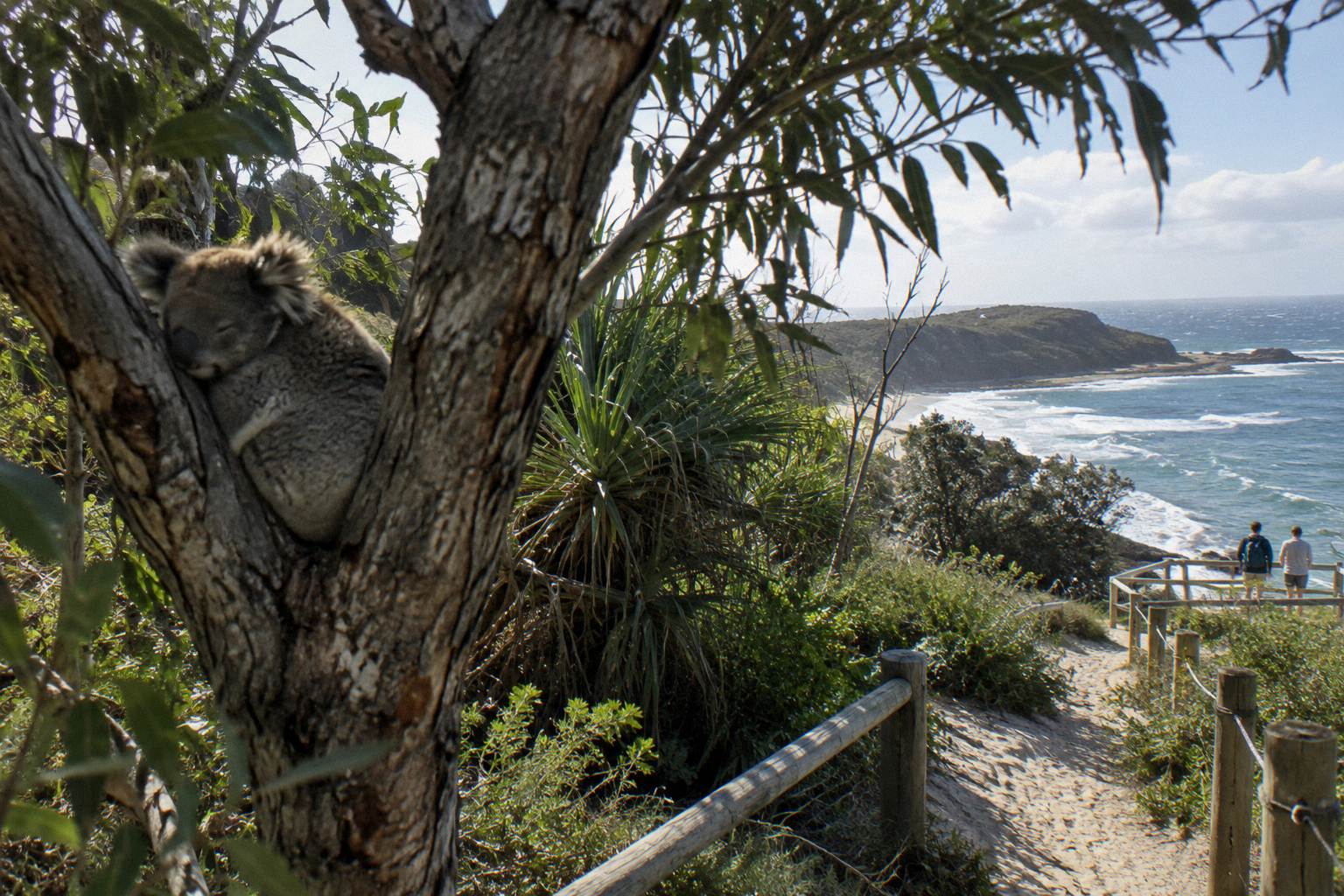
The koala population is the headline. Queensland Parks describes it as genetically distinct, which is not marketing language: it means the Straddie koalas are a separate breeding line from mainland populations, one of the reasons roughly half the island is protected inside Naree Budjong Djara National Park. Koalas sleep through much of the day in eucalyptus canopy, so spotting them is a scanning exercise, eyes up in the trees along the quieter roads and tracks, and a guide who drives the island daily has a real advantage over a first-time visitor.
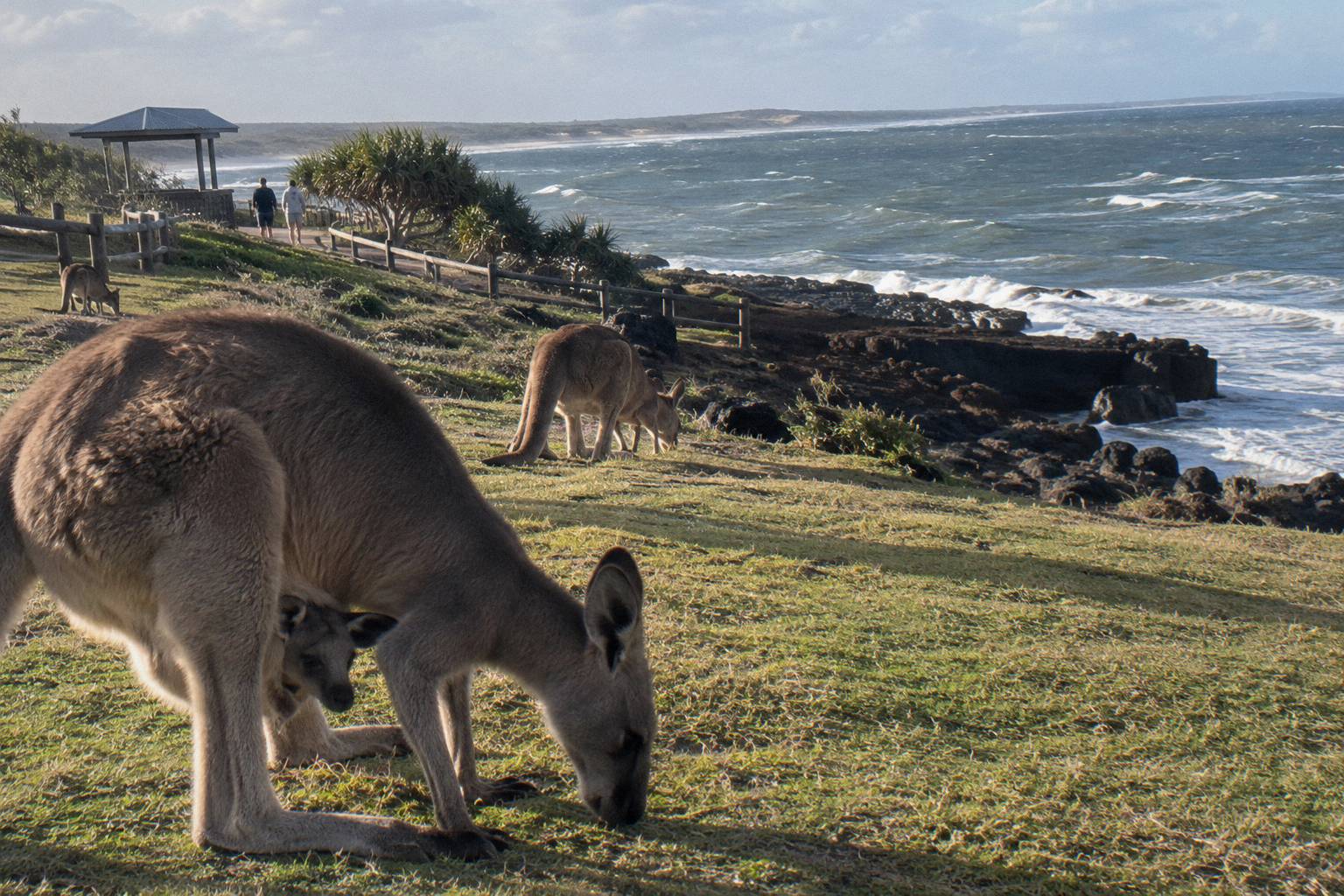
The golden wallaby deserves its own sentence. It is a form of the swamp wallaby that occurs on North and South Stradbroke only, which makes the island one of just two places on earth it exists. Kangaroos are more visible, particularly in the open grassy areas near Point Lookout in the cooler parts of the day. In the water, Queensland Parks names turtles, dolphins and manta rays as marine life around the island and says humpbacks, mantas and turtles are regularly seen from headlands, with dugong and grey nurse sharks in nearby waters of the marine park that surrounds the island.
| Animal | Where Queensland Parks places it | Your realistic chance |
|---|---|---|
| Koala | Genetically distinct population in the island's forests | Possible, best with eyes up in eucalypts and local knowledge |
| Kangaroo | Open grassland, notably around Point Lookout | Often visible in cooler hours |
| Golden wallaby | North and South Stradbroke only, a swamp wallaby form | Possible, shyer than the kangaroos |
| Turtle | Named marine life in the waters around the island | Possible from headlands and beaches |
| Dolphin | Named marine life in Moreton Bay | Possible, look from headlands |
| Manta ray | Named marine life, regularly seen from headlands | Possible in the clearer months |
| Humpback whale | Passes close to the coastline June to November | Seasonal, watched from land |
The table is the plain version of a wildlife brochure. Nothing on it is a stop on an itinerary, and no trip here books a wildlife sighting. What the guided trips do is put you in the places the animals use, at the times of day they use them, with a driver who knows where the last koala was sitting.
Where Are You Most Likely To See Koalas On Straddie?
Koalas live in the island's eucalyptus forests, and Queensland Parks describes the population as genetically distinct rather than concentrated in one viewing site, so there is no single guaranteed koala tree. The practical method is slow driving or walking with eyes scanning the canopy along forested roads, and the two trips whose booking pages say koalas are spotted with the guide both lean on a driver who scans those same corridors daily.
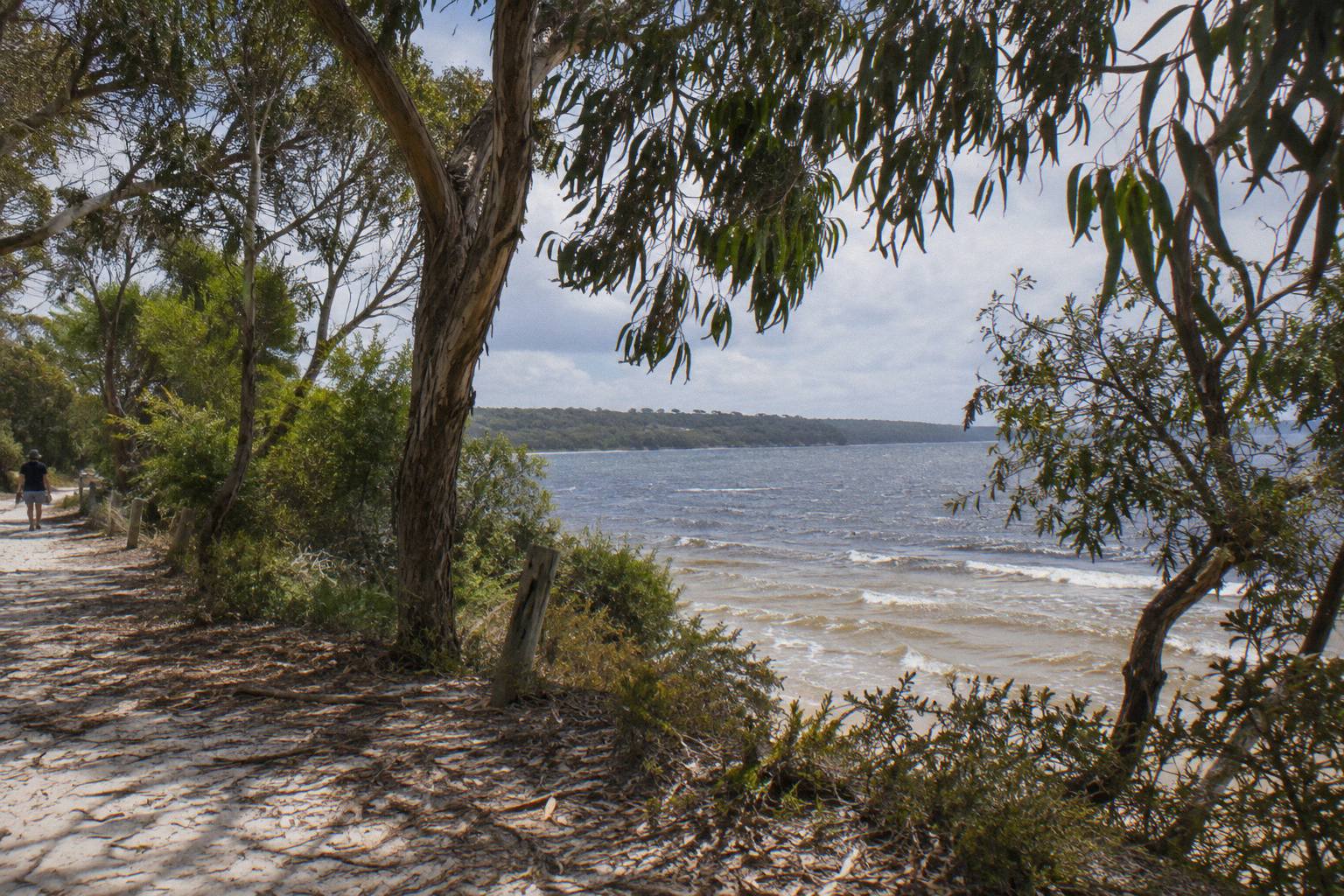
A self-guided visitor can do the same thing. The sealed roads between Dunwich, Amity Point and Point Lookout pass through enough eucalyptus for a patient passenger to find a koala, and the island's pace makes stopping safe on most stretches. What a guide adds is pattern recognition: which stretch of trees has produced sightings this week, which fork to watch, when to slow down. That is why the booking pages for the Wildlife And Beaches day trip and the Hit The Road Wildlife Day Trip phrase koalas as something spotted with the guide rather than a scheduled stop, and that phrasing is the accurate one.
Timing matters more than location. Koalas are most active in the early morning and late afternoon, which suits the day-trip schedule: the Hit The Road trip starts from outside the Adina Apartment Hotel Anzac Square in Brisbane at 7:45 AM, and the booking page warns there are two Adina hotels in the city, so check which one before you set out. From the 7:45 AM start, a 9 hours 30 minutes day puts you on the island across the middle of the day and back in Brisbane by evening, with the forested driving legs falling in the better morning light.
If koalas are the main reason you are going, a full guided day is the highest-effort-percentage option, and three of the trips here are built squarely around wildlife. The band below compares the three.
The Hit The Road Wildlife Day Trip is from A$149 per person, rated 4.9 from 547 reviews, the most reviews of any trip on the booking pages, running 9 hours 30 minutes in a group of up to 11 with the return ferry and bottled water included and lunch not included, the guide pointing you to takeaway options for a beachfront picnic or inviting you to bring your own. The Wildlife And Beaches day trip, from A$199 per person and rated 4.9 from 119 reviews, runs a longer 11 hours with beach games and swimming stops in the mix and koalas and kangaroos with the guide among its named experiences, picking up at points that include Pullman Brisbane King George Square, the SeaLink Departure Lounge Cafe in Cleveland and Novotel Surfers Paradise, which makes it workable from the Gold Coast as well as Brisbane.
Which Day Trips From Brisbane Look For Koalas And Kangaroos?
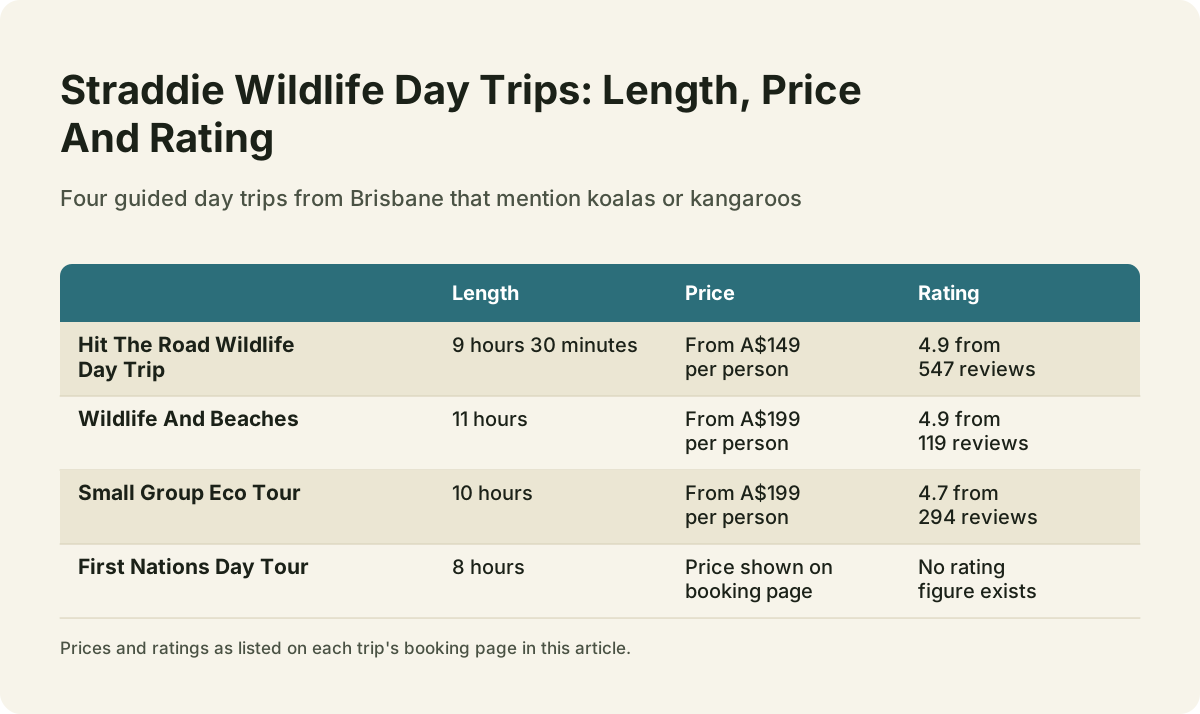
Four guided day trips from Brisbane mention koalas or kangaroos on their booking pages: the Hit The Road Wildlife Day Trip, the Wildlife And Beaches day trip, the Small Group Eco Tour and the First Nations Day Tour. The first three run as small-group trips with the return ferry included, while the fourth is a cultural day whose program includes kangaroos. Prices run from A$149 to A$199 per person.
Comparing trips means comparing formats, not operators. Length is the first fork: 8 hours, 9 hours 30 minutes, 10 hours, 11 hours. The second fork is what fills those hours. A wildlife-shaped day spends its time in the forest corridors and at headlands; a beaches-and-wildlife day splits the time between animal spotting and swimming stops with beach games; an eco tour day builds a lake stop, Myora Springs and a guided North Gorge Walk hike around the wildlife; a cultural day puts a 90-minute Quandamooka cultural experience first and lets wildlife appear along the way.
| Trip | Length | Koalas and kangaroos on the booking page | Price | Rating |
|---|---|---|---|---|
| Hit The Road Wildlife Day Trip | 9 hours 30 minutes | Koalas can be spotted with the guide; trip is built around wildlife | From A$149 per person | 4.9 from 547 reviews |
| Wildlife And Beaches | 11 hours | Koalas and kangaroos with the guide | From A$199 per person | 4.9 from 119 reviews |
| Small Group Eco Tour | 10 hours | Look for marine life and see koalas and kangaroos, never promised | From A$199 per person | 4.7 from 294 reviews |
| First Nations Day Tour | 8 hours | A cultural program that includes kangaroos | The price for your date shows on the booking page | No rating figure exists |
The Small Group Eco Tour, run by Queensland Day Tours, is the all-inclusive-shaped option: from A$199 per person, 4.7 from 294 reviews, 10 hours, meeting at Brisbane Skytower by CLLIX, 222 Margaret St, with hotel pickup and drop-off listed as not included. National park fees are in the price, the return ferry is in the price, and its stop list is the most specific among the day trips: a lake stop with free time on the shore, Myora Springs, a guided North Gorge Walk hike to Point Lookout, the fishing village of Amity, Cylinder Beach and Frenchmans Beach. Its marine list is dolphins, turtles, manta rays and whales, with koalas and kangaroos as land sightings, and its booking page is careful to frame every one as something to look for, which matches how the park service frames them too. It is not suitable for people with mobility impairments.
Booking early is worth a line here, less for price than for seats. The small-group wildlife trips cap at 11 people, and a 9 to 11 hour day with the ferry included is the kind of product weekend visitors book ahead for. Free cancellation up to 24 hours before start applies to every trip in this article, so reserving a date costs you nothing unless you cancel inside that window.
Can You See Turtles, Dolphins And Manta Rays From Straddie?
Queensland Parks names turtles, dolphins and manta rays as marine life around the island and says all three, alongside humpbacks, are regularly seen from the headlands, so your viewing platform is land, not a boat, and no whale or dolphin cruise exists among the day trips from Brisbane. The headlands at Point Lookout are the vantage the park service points to, and the trips that name these animals bring you to headland viewpoints rather than onto the water. See also do dolphins come close at Amity Point.
Marine watching on Straddie is a patience game played from rock platforms. Turtles surface on their own schedule, dolphins move through the bay in pods, and manta rays are most often picked out as dark shapes gliding under the surface on clear days. The three guided trips that include a North Gorge Walk or headland stop give you the longest structured look: the Small Group Eco Tour hikes the headlands with a guide, and the whale-season bonus is that the same rock platform serves both the turtle-and-ray watch and the humpback migration.
Amity Point sits on the western side and is a different water view, over the bay rather than the ocean. The Small Group Eco Tour includes a visit to the fishing village of Amity on its route. If you are weighing a ferry-and-bus day built around Amity, the question of dolphins and koalas at Amity Point is covered in detail in its own guide, which sticks to what the official pages say and nothing more.
One caution the park service is blunt about: Amity Point has an enclosed swimming area, and you should not swim in the deep channel off Amity Point, which carries strong currents and possible sharks. Watching marine life from the shore and swimming there are two different activities, and only the first is unconditionally safe.
Can You Watch Whales From North Stradbroke Island?
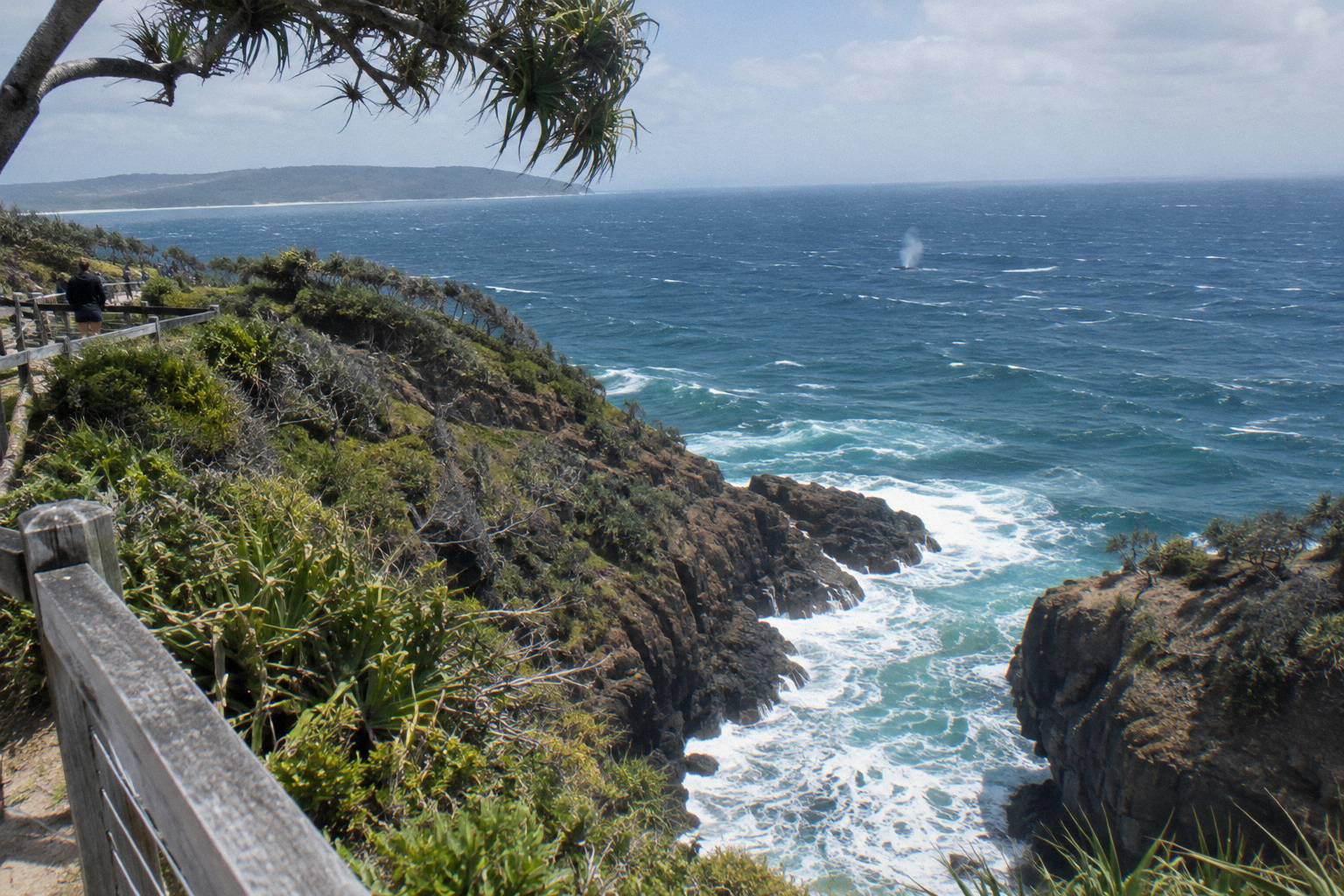
Humpback whales pass close to the coastline of North Stradbroke Island from June to November on their annual migration, and Queensland Parks says humpbacks, manta rays and turtles are regularly seen from the headlands at Point Lookout, including along the North Gorge Walk. There is no whale-watching cruise among the day trips from Brisbane: every whale sighting here is from land, and no sighting is ever promised.
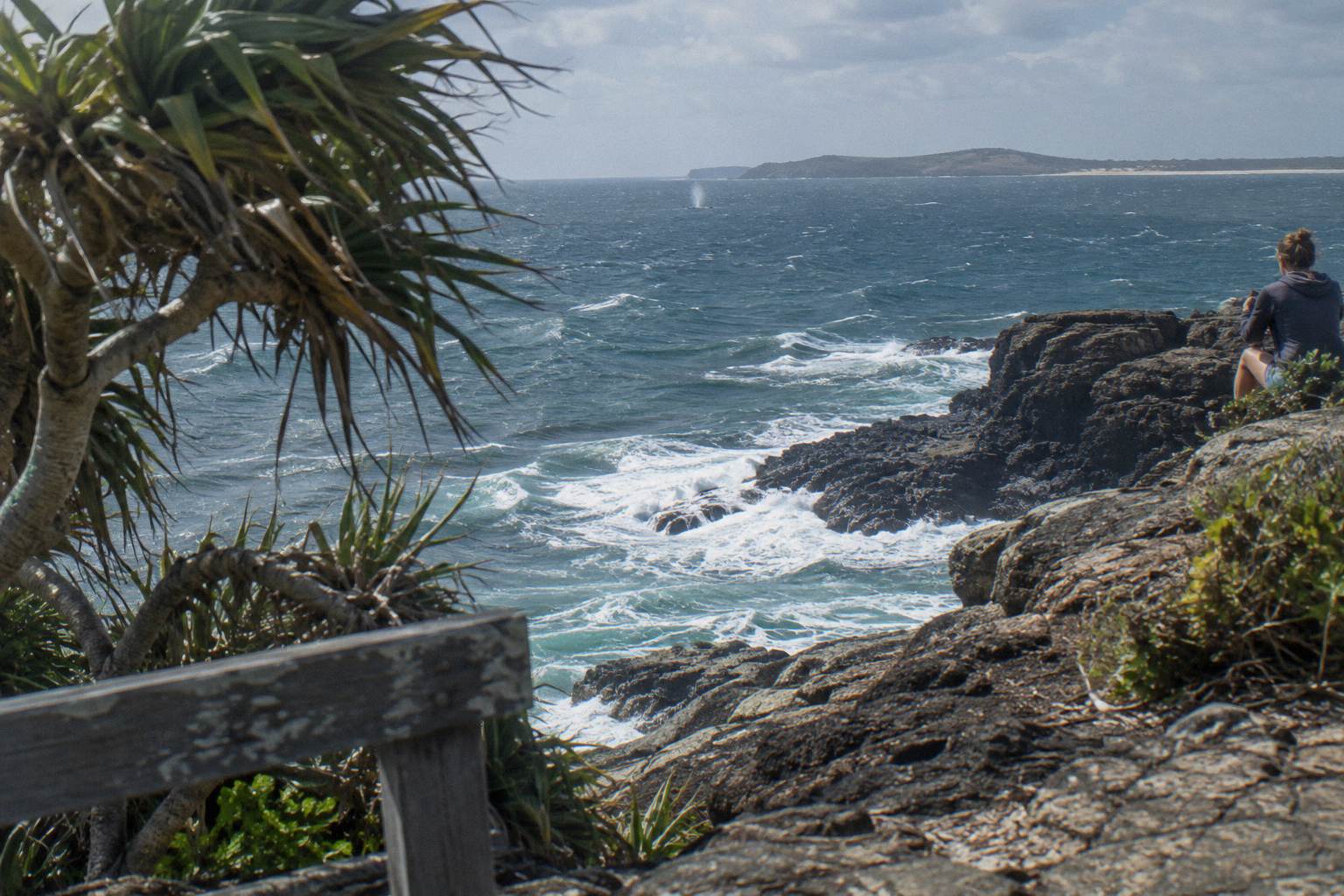
The season window is worth internalising because it is wider than most people expect. June to November, stated exactly as Queensland Parks states it, covers the northbound and southbound legs of the migration, and Point Lookout's headlands sit close enough to the coastline route that whales pass within view of the walking track. Three trips mention whales on their booking pages: the 4WD Beach Day lists whales June to November, the Small Group Eco Tour lists whales among the marine animals to look for, and the Indigenous Culture Day Tour lists seasonal whales along the way.
The Indigenous Culture Day Tour is the whale-season pick if culture is part of what you want from the day. From A$359 per person for an 11-hour day with the return ferry, return transfers from designated Brisbane city meeting points, lunch of a Prawn Shack prawn and avocado roll with a cold drink, a 90-minute cultural experience with a local Quandamooka guide, Myora Springs (Capembah), the North Gorge headland walk and Brown Lake (Bummiera), it runs on set days, so check the booking page for your dates. Wildlife spotting, seasonal whales included, happens along the way rather than as the organising idea. Stradbroke Island Tours runs both this trip and the Wildlife And Beaches day trip as two formats of one service, one culture-first and one beaches-and-wildlife, and comparing those two formats is a fair way to decide what your day is for.
If the migration is the reason you are travelling, the seasonal detail, the headland vantage points and the realistic odds are worked through in the guide to the Straddie whale watching season, which covers June to November from the same official sources.
Is The North Gorge Walk The Best Wildlife Walk On The Island?
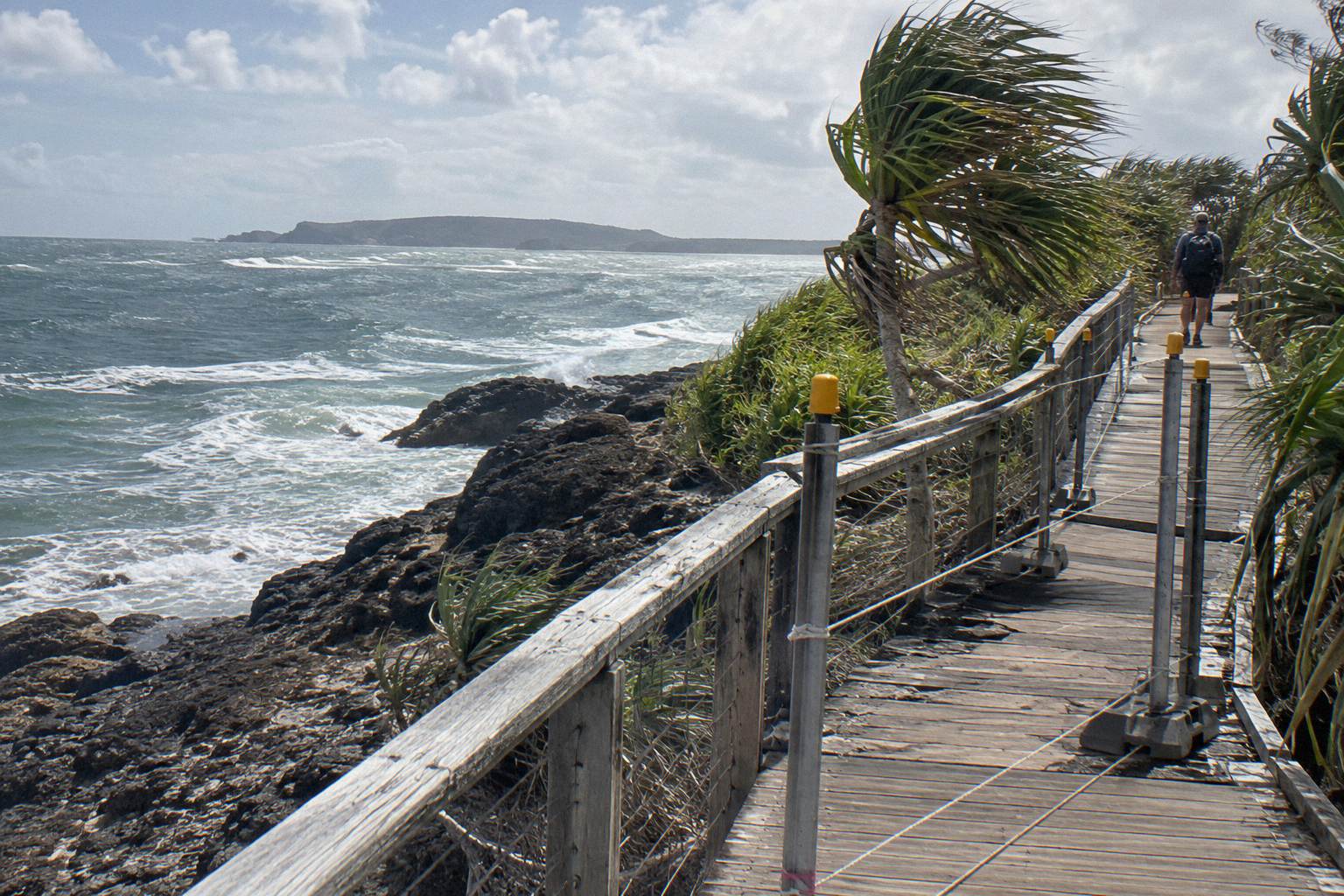
Yes, for marine wildlife the North Gorge Walk at Point Lookout is the island's best walk: this 1.2 km self-guided route along the rocky headlands is the most productive stretch of track on the island, with turtles, dolphins and manta rays named by Queensland Parks as marine life of this coast. The park service calls it a gentle walk with ocean views, but it is partly closed, so check before you go.
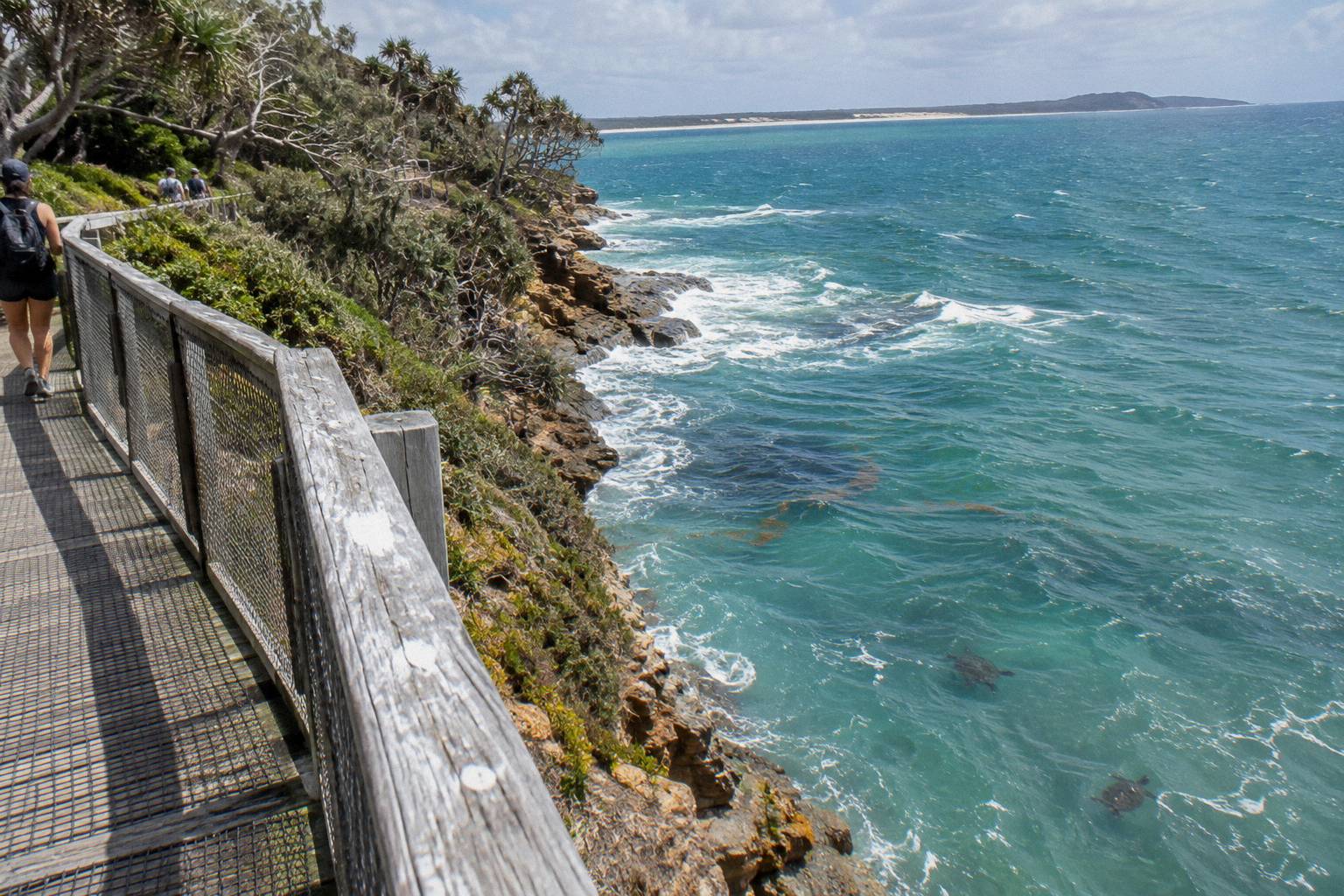
Use only the 1.2 km figure: the park service publishes the distance but no walking time or grade beyond the word gentle, and any blog that hands you a minutes-per-kilometre estimate is inventing it. What the walk delivers is time at elevation over water. You stand above the ocean rather than beside it, which is exactly the geometry that makes headland wildlife watching work, and Queensland Parks is the source for the claim that humpbacks, manta rays and turtles are regularly seen from headlands like these.
The guided version has an advantage you can feel: a local guide on the Small Group Eco Tour hikes the headlands with the group and knows where eyes should go, and the same walk appears on the Indigenous Culture Day Tour and the Meanjin To Minjerribah First Nations Day Tour, the latter an 8-hour First Nations cultural day from Brisbane from 280 Ann Street in the CBD with lunch, entry fees and ferry transfers included, a program that features kangaroos, the Point Lookout Gorge Walk, white-sand beaches and a Brown Lake stop. The price for your date shows on the booking page. The full route detail, the closure history and what to expect underfoot are in the North Gorge Walk trail guide.
A note on the wallabies while we are on foot: the golden wallaby is the quiet star of the island's land wildlife precisely because it exists nowhere else in this form. It is a swamp wallaby rather than a kangaroo, shyer, more often in cover, and most likely to be seen in the early morning or late afternoon. Kangaroos graze more openly and give you the classic photo opportunity; the wallaby you may earn.
Guided Tour Or Go Yourself: Which Gives You Better Wildlife Odds?
A guided small-group day trip gives you better wildlife odds, because a driver who scans the same forest corridors every day spots koalas a first-time visitor drives straight past. Trips from A$149 per person bundle the ferry, the driving and the headland time into one decision, while going yourself costs less and hands you the clock, but leaves you to find the animals, the parking and the ferry timing alone. Remember that sightings are never guaranteed.
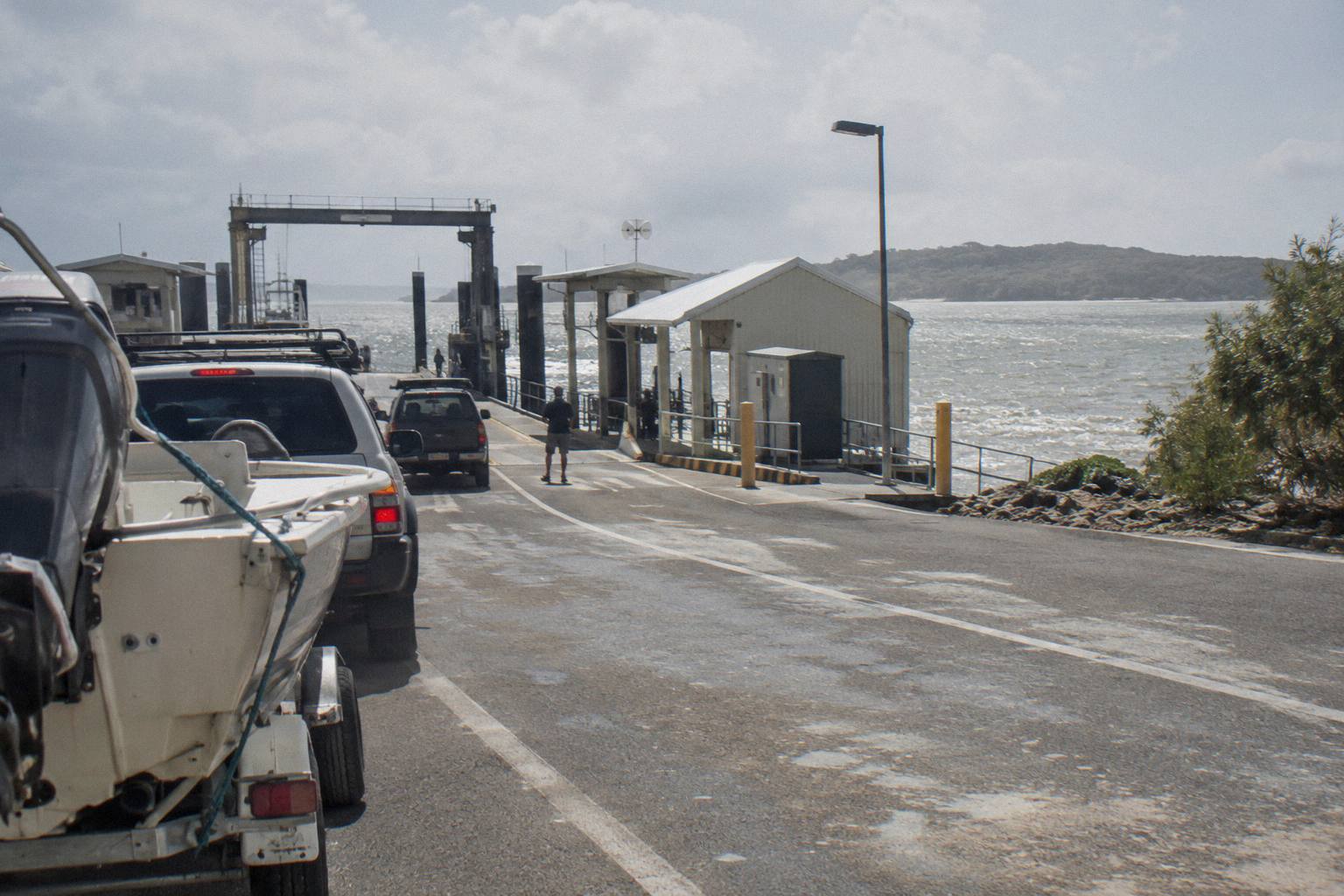
The arithmetic is not about money alone. A day trip like the Hit The Road Wildlife Day Trip, from A$149 per person for 9 hours 30 minutes with the return ferry ticket, bottled water and an air-conditioned vehicle in the price, converts your day into guided scanning time; lunch is not included and the guide recommends takeaway options for a beachfront picnic, or you bring your own. Doing it yourself means a passenger ferry of about 25 minutes from Cleveland to Dunwich, tickets valid on any service for 365 days from purchase and bought online or at the terminal but no longer onboard, then island buses on routes 880 and 881 that connect all three townships and take paper tickets only, at A$0.50 single, A$1.00 daily and A$5.00 weekly, with go cards not accepted.
| Format | Trip or method | Length | Meeting or start | What it handles for you |
|---|---|---|---|---|
| Small-group wildlife day | Hit The Road Wildlife Day Trip | 9 hours 30 minutes | 7:45 AM outside Adina Anzac Square, Brisbane | Ferry, driving, guiding, water |
| Small-group beaches and wildlife | Wildlife And Beaches | 11 hours | Meeting points in Brisbane, Cleveland, Surfers Paradise | Ferry, driving, guiding, beach games |
| Small-group eco day | Small Group Eco Tour | 10 hours | Brisbane Skytower by CLLIX, 222 Margaret St | Ferry, park fees, guiding, gorge hike |
| Do it yourself | Ferry and island buses | Your call | Cleveland terminal, tickets valid 365 days | Nothing, but full control of the clock |
Both approaches work, and the full comparison, ferry logistics, bus routes and what a day without a car actually looks like, is laid out in the guide to Straddie without a car. What tips most people toward a guide is the koala problem: the animal is genuinely findable, but finding it is a skill, and the two Adina hotels aside, the hardest part of a Straddie wildlife day is not getting there, it is looking in the right tree.
The Wildlife And Beaches day trip splits the difference if your group is mixed on wildlife enthusiasm, pairing the koalas-and-kangaroos leg with beach time, swimming stops and beach games across 11 hours, from A$199 per person, rated 4.9 from 119 reviews, in a group of up to 11 with the return ferry included. Not everyone in a family wants six hours of canopy scanning, and this format lets the wildlife watchers watch while the swimmers swim.
Wildlife Rules On Straddie That Actually Matter
The wildlife rules that matter most on Straddie are these: dogs are banned from Naree Budjong Djara National Park, pets cannot ride the island's public buses, visitors must stay on the tracks and carry rubbish out, and flying a drone over the park means CASA rules apply and a Queensland Government permit may be required. All wildlife is protected under the joint management arrangement between the Quandamooka people and QPWS, in place since 2011.
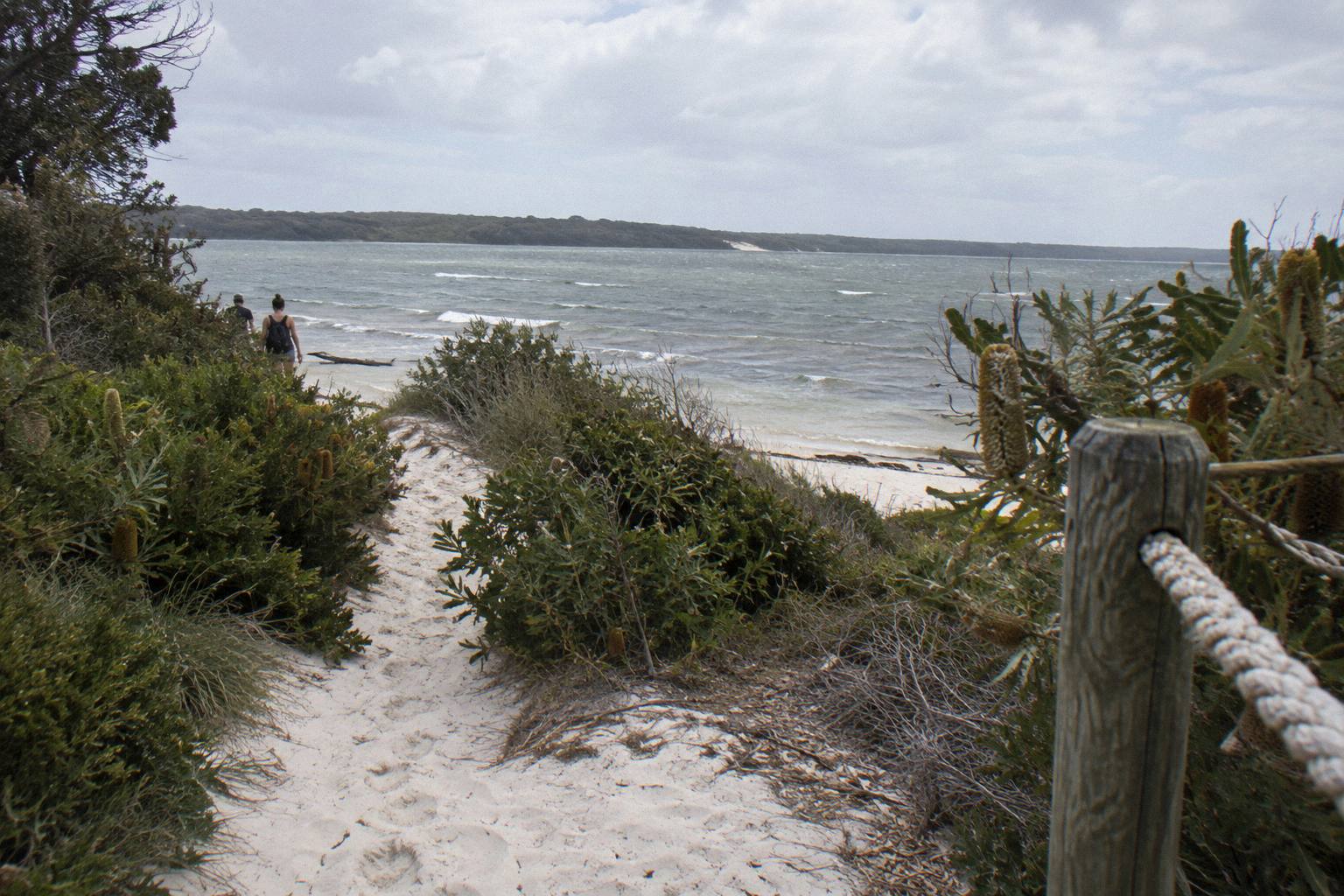
The practical version for a wildlife day is short. Feeding animals is out, obviously, but so is getting close for photos: a koala that moves off its branch because a crowd has gathered under it has burned energy it budgeted for sleeping. Queensland Parks also asks visitors not to swim in Kaboora (Blue Lake), a place of significant cultural value to the Quandamooka people, and notes that swimming and sunscreen pollute lakes and lagoons generally, which is why the Small Group Eco Tour's lake stop is described as free time on the shore rather than a swimming stop. If a koala or kangaroo is injured, the number to call is Wildlife Rescue Minjerribah on 0448 466 556.
The climate shapes the day more than the rules do. Bureau of Meteorology averages for Point Lookout put the mean maximum at 29.6 °C in January and 21.2 °C in July, with mean annual rainfall of 1,517.7 mm, the driest months September at 53.7 mm and August at 68.9 mm and the wettest March at 179.6 mm. Land wildlife is easier to find in the cooler hours year round, and the June to November whale season adds a species to the list without subtracting anything, since the koalas, kangaroos and wallabies are residents, not migrants.
Whether a full guided day justifies its price against a ferry-and-bus DIY day is a fair question with a real answer for most travellers, and it is argued out fully, numbers included, in the piece on whether a Straddie tour is worth it or going DIY is better.
Common Questions About Straddie Wildlife
Will I Definitely See Koalas On North Stradbroke Island?
No, and no operator or official source will tell you otherwise. Queensland Parks confirms a genetically distinct koala population lives on the island, and the trips whose booking pages mention koalas frame them as spotted with the guide, never as a scheduled stop. Your odds are better with a guide who scans the same forest corridors daily.
Are There Kangaroos On North Stradbroke Island?
Yes. Kangaroos are among the animals Queensland Parks names for the island, and they are often visible in open grassy areas around Point Lookout in the cooler parts of the day. The island also has the golden wallaby, a swamp wallaby form found on North and South Stradbroke only.
When Can You See Whales On Straddie?
Humpback whales pass close to the coastline of the island from June to November on their annual migration, and Queensland Parks says humpbacks, manta rays and turtles are regularly seen from the headlands at Point Lookout, including along the North Gorge Walk. All whale watching here is from land: no whale cruise, boat or kayak trip exists among the day trips.
Which Tour Is Best For Wildlife On North Stradbroke Island?
The Hit The Road Wildlife Day Trip is the one built squarely around wildlife, from A$149 per person for 9 hours 30 minutes, rated 4.9 from 547 reviews, with the return ferry included. The Wildlife And Beaches day trip and the Small Group Eco Tour, both from A$199 per person, also look for koalas, kangaroos and marine life while adding beach time or a lake-and-gorge itinerary.
Can You See Dolphins And Turtles At Amity Point?
Dolphins and turtles are named marine life in the waters around the island, and headlands are the vantage Queensland Parks points to. Amity Point has an enclosed swimming area, and you should not swim in the deep channel off Amity Point, which has strong currents and possible sharks. No trip names a dolphin stop at Amity Point, so treat any sighting there as possible, never planned.
Is The North Gorge Walk Good For Seeing Wildlife?
Yes, it is the most productive single stretch of track on the island for marine wildlife: a 1.2 km self-guided walk along the rocky headlands with turtles, dolphins and manta rays named as marine life of this coast and humpbacks passing close from June to November. The walk is partly closed, so check before you go, and never expect a guaranteed sighting.
Planning a Straddie day around animals is really planning around two clocks: the daily one, which puts koalas and kangaroos in the open early and late, and the seasonal one, which adds whales from June to November. Get both right, keep your expectations at possible rather than promised, and the island delivers one of the better wildlife days within commuting distance of a capital city anywhere in Australia.